Commercial kitchens face the highest fire risk of any business environment. Your hood suppression system must be professionally inspected every six months. FSI New Mexico provides complete NFPA 17A compliant testing for restaurants, hotels, and food service facilities across New Mexico.
Commercial cooking equipment generates intense heat, grease vapors, and combustible residue at a rate unlike any other occupancy. A grease fire can escalate from manageable to uncontrollable in under 30 seconds — faster than any person can react, faster than a fire department can respond.
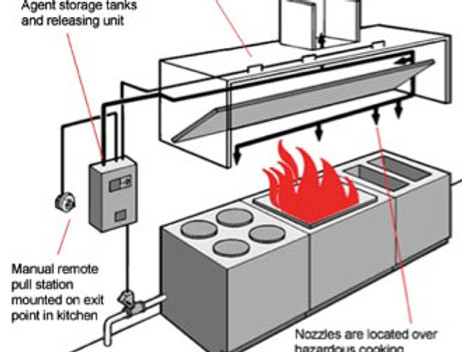
The wet chemical suppression system installed beneath your exhaust hood is engineered to activate automatically, smothering the fire with a fine mist of potassium-based agent before it can spread. But only if the system is properly maintained.
NFPA 17A and NFPA 96 mandate that every commercial kitchen hood suppression system be inspected and tested by a certified professional at least every six months. Grease accumulation, nozzle clogging, and agent degradation can silently render your system inoperable between inspections. In New Mexico, a failed or overdue inspection can result in fines, required closure, and voided insurance coverage. Read our detailed Albuquerque restaurant kitchen fire suppression requirements guide to learn about hood inspections, cleaning schedules, and local code enforcement. Additionally, commercial kitchens are required to have a certified Class K fire extinguisher within 30 feet of cooking surfaces. You can read more about extinguisher placement in our Albuquerque fire extinguisher installation requirements guide.
NFPA 17A mandates bi-annual inspections for wet chemical suppression systems in commercial kitchens.
Cooking fires are the leading cause of commercial structural fires in the United States according to the NFPA.
Our thorough inspection protocol covers every component of your kitchen suppression system, following the full checklist required by NFPA 17A and NFPA 96.
We review existing system design documentation, service records, and previous inspection reports to identify recurring issues before beginning the physical inspection.
The hood canopy, exhaust ductwork, and grease filters are inspected for grease accumulation, obstructions, and structural integrity. Excessive buildup is a critical fire hazard.
All suppression agent nozzles are inspected for proper orientation, blockage, and cap condition. Nozzle placement must provide complete coverage of the cooking equipment below.
Wet chemical agent containers are weighed or measured to verify adequate agent charge. Expander tubes, actuation lines, and pressure indicators are checked.
Fusible link detectors are inspected and tested. Automatic gas shut-off valves, exhaust fan interlocks, and electrical disconnects are verified for proper function.
The manual pull station is tested to confirm it correctly activates the suppression system — a critical failsafe for when automatic detection doesn't trip.
After testing, the system is properly reset, all pull pins and tamper indicators replaced, and the system is restored to fully operational status.
A detailed bi-annual inspection report is provided, suitable for the health department, fire marshal, and insurance carrier. Deficiencies are itemized with corrective action recommendations.
Our technicians are trained to the following standards governing commercial kitchen fire suppression in New Mexico.
Wet Chemical Extinguishing Systems — requires bi-annual inspection and annual thorough examination of all commercial kitchen suppression systems.
Standard for Ventilation Control and Fire Protection of Commercial Cooking Operations — governs hood design, grease management, and suppression requirements.
The testing standard for restaurant fire suppression systems. Most commercial kitchen systems must be UL 300 certified to meet current code requirements.
Adopts NFPA 96 requirements. Local fire marshals conduct periodic inspections of commercial kitchen fire suppression systems and enforce compliance.
Any commercial kitchen with a hood suppression system requires bi-annual testing. We work with all types of food service and hospitality operations.